2028 Mazda MX-30 Redesign, Specs, Interior – The 2028 Mazda MX-30 could represent a very different vehicle from the compact electric crossover that originally introduced Mazda’s modern electrification strategy. The original MX-30 arrived in 2020 as Mazda’s first mass-production battery-electric vehicle, combining a relatively small battery with distinctive styling, freestyle doors and an interior built around materials such as cork and recycled fibers. Mazda later expanded the concept with the MX-30 e-Skyactiv R-EV, a series plug-in hybrid that used a rotary engine exclusively as a generator rather than mechanically driving the wheels. The R-EV demonstrated that Mazda was willing to approach electrification differently instead of simply copying the battery strategies used by larger manufacturers.
There is an important caveat surrounding the 2028 model. Mazda has not officially confirmed a production vehicle called the 2028 MX-30, and the company discontinued the MX-30 EV in the United States after the 2023 model year. Mazda’s current North American electrification strategy shifted toward larger plug-in hybrids and hybrid products, while its global roadmap is moving toward a much broader battery-electric portfolio later in the decade. Consequently, any discussion of a 2028 MX-30 must distinguish confirmed Mazda strategy from projections. A future MX-30 could return, but it would likely need substantially more range, faster charging and broader practicality than the original model to justify its place in a rapidly changing EV market.
Mazda’s long-term strategy makes the possibility particularly interesting. The company currently describes 2025–2027 as a transition period toward electrification and 2028–2030 as the phase for a full-scale launch of battery-electric vehicles. Mazda is also developing its first dedicated EV platform, designed to accommodate different battery configurations and future derivatives while preserving the brand’s focus on responsive driving and craftsmanship. That means a future MX-30, if revived, could potentially move away from the original model’s limited-range architecture and use technology developed specifically for Mazda’s next generation of EVs.
The strongest 2028 scenario would therefore be a compact Mazda electric crossover that keeps the original MX-30’s unconventional personality while solving its most obvious limitations. A larger and more energy-dense battery, faster DC charging, improved cabin packaging and a more efficient electric drivetrain would make the name considerably more competitive. Mazda could also revisit the rotary range-extender concept, although there is no confirmation that a future MX-30 will use one. The company continues to develop rotary-engine technology and has specifically discussed applying combustion improvements to a future rotary-engine emissions roadmap, keeping the door open to further innovation without guaranteeing a production application. 2028 Mazda MX-30 Redesign
2028 Mazda MX-30 Redesign and Update Plan
Exterior & Interior
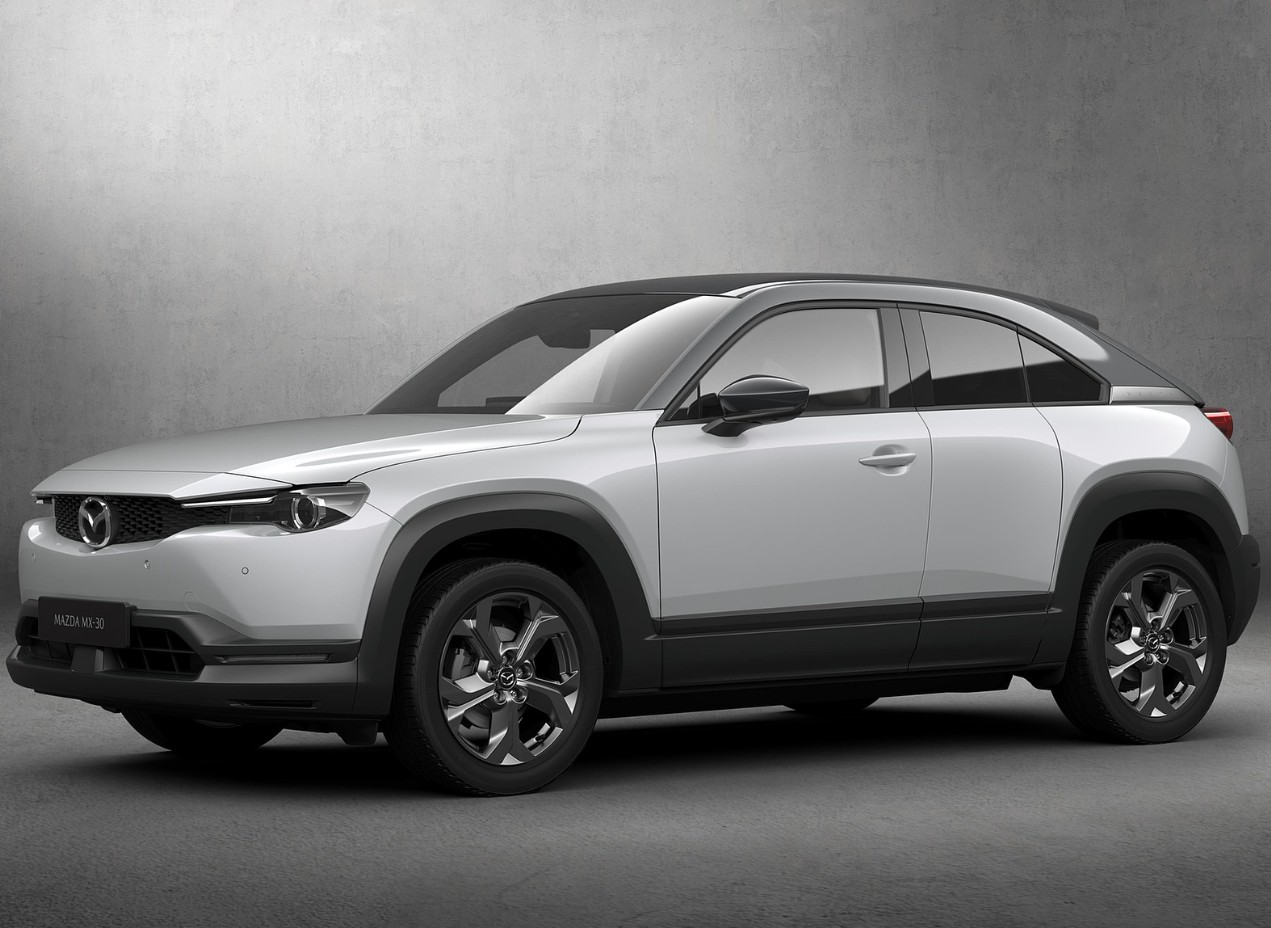
The first MX-30 established a design language that was deliberately different from the conventional Mazda crossover range. Its body featured a compact footprint, a floating-style roof, deeply sculpted surfaces and freestyle rear doors that opened toward the back. The unusual door arrangement helped create a more open feeling when the front and rear doors were opened together, although it also introduced practical limitations because the rear doors depend on the front doors being opened first. For 2028, Mazda could retain the visual identity while adopting conventional rear doors if customer practicality becomes a higher priority.
A redesigned exterior could also make the MX-30 look more technologically advanced without turning it into a generic EV. Mazda’s Kodo design philosophy could be adapted to create cleaner surfaces and a more aerodynamic body. The front end would likely use a closed grille treatment with a recognizable Mazda signature rather than a completely blank panel. Slim LED headlights could extend horizontally from the central badge, while a full-width rear light signature could emphasize the vehicle’s width. Two-tone paint, contrasting roof colors and distinctive wheel designs would help preserve the personalization options that were part of the original model’s identity.
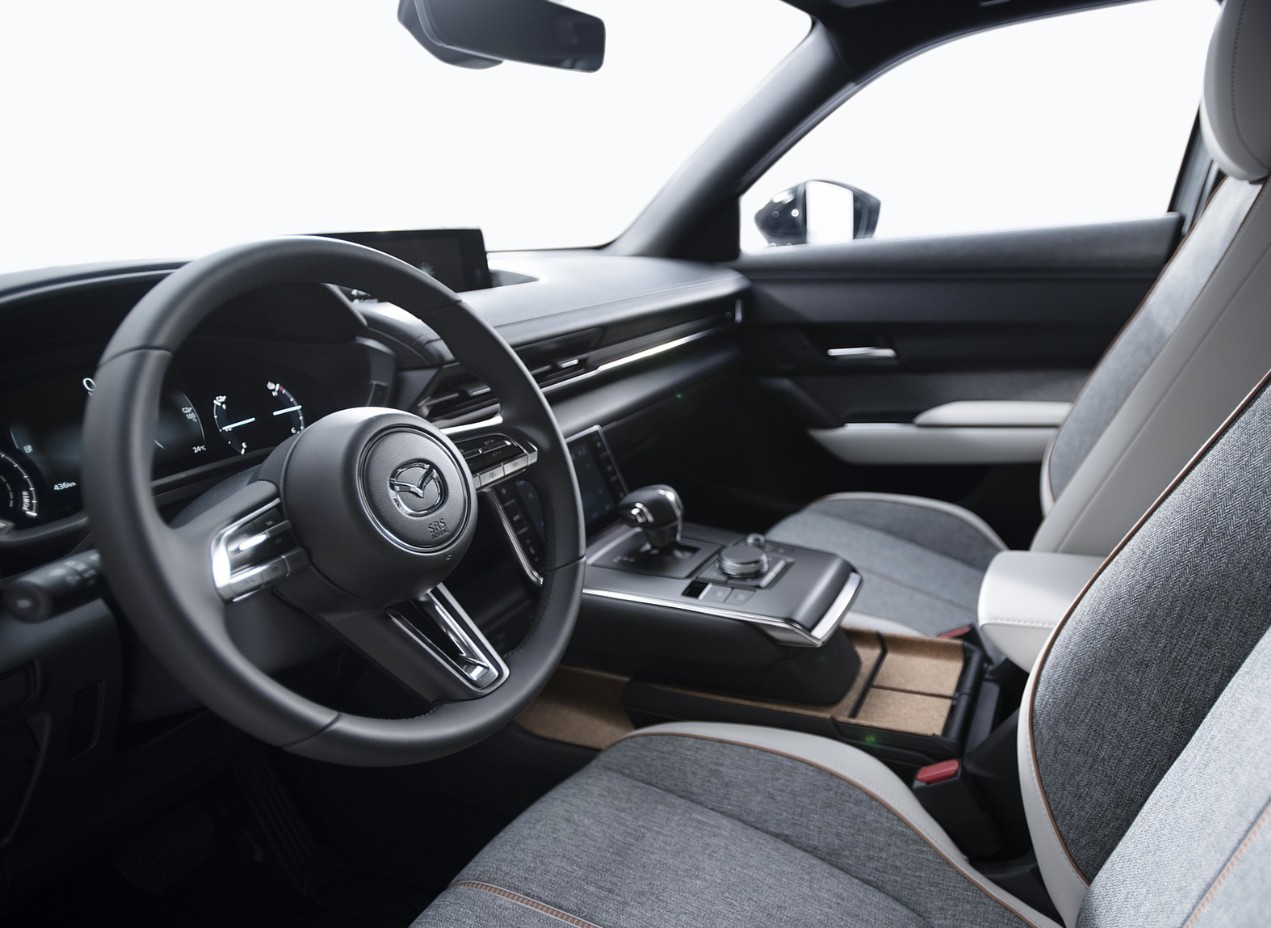
The cabin could remain one of the MX-30’s strongest differentiators. Mazda originally used cork in the center console and recycled textile materials in the seats, connecting the vehicle to the company’s historical roots as a cork manufacturer. That approach could be expanded in 2028 with more sustainable textiles, recycled plastics, bio-based materials and carefully finished wood or cork surfaces. Rather than filling the cabin with excessive glossy screens, Mazda could emphasize tactile controls, premium upholstery and a driver-oriented layout. The result would be a cabin that feels different from the technology-heavy interiors common among newer EV competitors.
Practicality would nevertheless need to improve. A future MX-30 could offer more rear-seat legroom, a larger cargo area and better storage around the center console. A dedicated EV platform could free designers from some of the packaging compromises of the original architecture. The dashboard could feature a larger central display, a configurable digital instrument cluster and a modern head-up display, while wireless Apple CarPlay and Android Auto would be expected. Mazda could also add advanced connected services that show charging locations, battery status and predicted range directly through the vehicle or smartphone application. The premium versions could offer Bose or another high-end audio system, panoramic glass and more advanced seat ventilation.
A future MX-30 would need a significant redesign rather than a simple facelift. The original model’s 35.5-kWh battery was deliberately selected around Mazda’s philosophy of avoiding an unnecessarily large battery for daily urban use. Mazda explained that battery production has environmental consequences and that a smaller pack could reduce vehicle weight, cost and lifecycle impact. That approach made engineering sense when the MX-30 was conceived, but the modern EV market has moved toward substantially greater range and faster charging. A 2028 model would probably require a new battery architecture capable of supporting longer trips while maintaining reasonable weight.
Mazda’s dedicated EV platform could provide the foundation for such a vehicle. The company says its upcoming battery-electric architecture is being developed to accommodate different battery types and vehicle derivatives while supporting Mazda’s Jinba-Ittai driving philosophy. This is significant because the original MX-30 used a platform adapted around a relatively modest battery, whereas a dedicated EV architecture can package a larger battery more efficiently between the axles. A future MX-30 could therefore have a lower center of gravity, improved cabin space and better weight distribution without requiring the vehicle to become dramatically larger.
Exterior development would probably focus heavily on aerodynamic efficiency. The original MX-30 deliberately avoided the anonymous shape common to many compact EVs, using a coupe-like roof, a relatively upright body and distinctive freestyle doors. A future version could retain the recognizable silhouette while smoothing the front fascia, narrowing the lighting elements and reshaping the rear roofline to reduce drag. Active grille shutters would be unnecessary for a pure EV’s powertrain cooling requirements but could be replaced by controlled air channels around the bumper and wheels. Flush door handles, aerodynamic wheels and a carefully managed underbody could further improve highway efficiency.
The chassis could also become more sophisticated without abandoning Mazda’s emphasis on natural handling. The original MX-30 used electric G-Vectoring Control Plus to manage motor torque and vehicle load, allowing Mazda to preserve familiar steering and cornering characteristics in an EV. A future model could integrate this concept with predictive torque management, more advanced regenerative braking and electronically controlled dampers. Rear-wheel drive could even be considered for a sportier derivative, although front-wheel drive or dual-motor AWD would be more practical for the mainstream version. The key would be maintaining a relatively lightweight feel instead of turning the MX-30 into another heavy electric SUV.
2028 Mazda MX-30 Specs
Engine & Performance
The original MX-30 EV’s powertrain was modest by modern EV standards. Its 35.5-kWh battery powered a front-mounted electric motor producing approximately 107 kW, or 143 horsepower, with around 270 Nm of torque. Mazda deliberately kept the battery relatively small to limit weight and environmental impact. In the United States, the result was an EPA-estimated 100-mile range. Mazda itself described the vehicle as being designed primarily for daily commuting and urban driving rather than long-distance touring.
The 2028 version would need substantially stronger specifications if Mazda wants the MX-30 name to compete internationally. A reasonable projection would be a battery somewhere around 65–80 kWh, depending on vehicle size and chemistry, paired with an electric motor producing approximately 200–250 horsepower in the standard model. An AWD dual-motor version could potentially reach 300 horsepower or more. Those figures are not official Mazda specifications, but they would place a future MX-30 much closer to the performance and range expectations of late-2020s compact electric crossovers. More importantly, Mazda could prioritize low weight and efficient energy management rather than chasing extreme output.
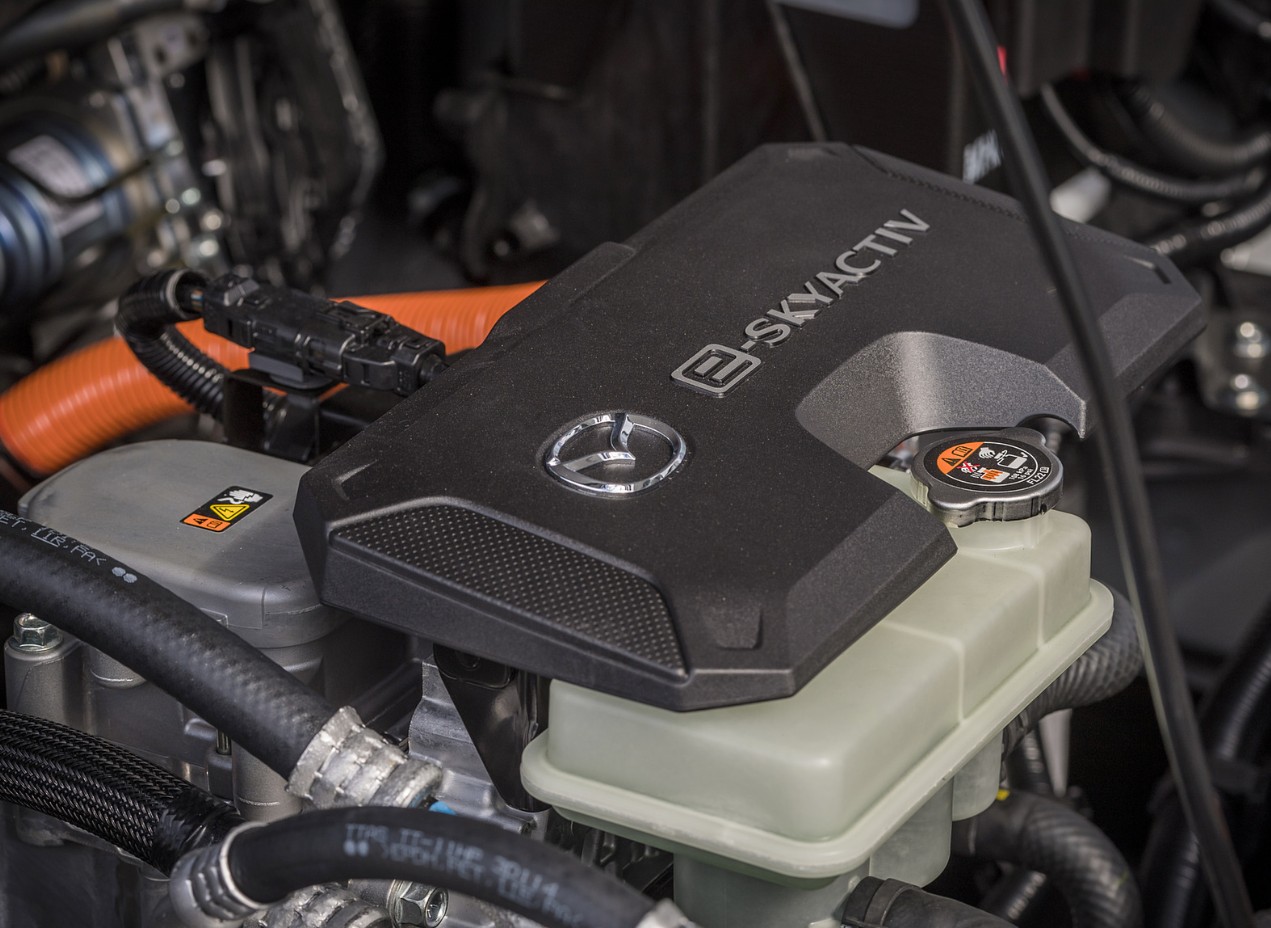
The rotary-powered MX-30 R-EV offers another intriguing possibility. Its series plug-in hybrid architecture uses an 830-cc single-rotor engine connected to a generator, while a 125-kW electric motor drives the wheels. The 17.8-kWh battery provides approximately 85 km of WLTP electric range, and the 50-liter fuel tank allows substantially longer total journeys. Because there is no mechanical connection between the rotary engine and the wheels, the vehicle retains electric drive characteristics even when the generator is operating. This is one of the most technically distinctive production applications of Mazda’s rotary technology in decades.
For 2028, a rotary range extender could theoretically return in a more advanced form, particularly if Mazda wants to offer an electric crossover for markets where charging infrastructure remains inconsistent. However, this should be regarded as a possibility rather than an expected specification. Mazda’s official strategy emphasizes both battery EVs and multiple electrification technologies, but it has not announced a 2028 MX-30 rotary model. If the company does revisit the concept, improved thermal efficiency, a larger battery, faster charging and a more efficient generator could give the system greater value than the original R-EV.
2028 Mazda MX-30 Fuel Economy
Efficiency would likely become more important than outright horsepower. A future battery-electric MX-30 with around 280–330 miles of EPA-class range could offer a strong balance between urban usability and highway travel, assuming Mazda keeps aerodynamic drag and curb weight under control. A rotary range-extender model would be evaluated differently because its electric range and total range would be separate measurements. The original R-EV achieved an electric-only WLTP range of 85 km and a total range exceeding 600 km depending on specification and testing conditions, while Mazda quoted combined WLTP fuel consumption around 1.0 L/100 km under the relevant test methodology. Real-world results would naturally depend on how frequently the battery is charged and how much the generator is used.
2028 Mazda MX-30 Safety Features
Safety technology would also have to evolve significantly. The original MX-30 already offered Mazda’s i-Activsense driver-assistance systems, and the U.S. Premium Plus package added features including a 360-degree View Monitor, front parking sensors and Blind Spot Assist. A 2028 vehicle could take these systems considerably further with improved pedestrian and cyclist detection, intersection collision avoidance, lane-centering assistance, adaptive cruise control with enhanced traffic recognition, blind-spot intervention and rear cross-traffic braking. Highway assistance could become more capable while remaining supervised by the driver. A more advanced camera and radar package could also support safer parking in tight urban environments.
2028 Mazda MX-30 Release Date & Price
The release date is currently impossible to state as a confirmed calendar event because Mazda has not announced a 2028 MX-30. Nevertheless, the company’s corporate roadmap makes the late 2020s particularly relevant. Mazda describes 2028–2030 as the period for a full-scale launch of battery-electric vehicles, while its dedicated EV platform is being developed specifically for future BEV products and derivatives. If Mazda decides that the MX-30 name remains valuable, a replacement or heavily redesigned version could logically appear around 2027 or 2028. Such a vehicle would likely be positioned differently from the original rather than simply reproducing its short-range formula.
The more conservative possibility is that Mazda retires the MX-30 name and applies its next-generation EV technology to another crossover nameplate. Mazda’s current global product strategy already includes new electrified models, including the Mazda6e and upcoming dedicated EV products, while the company is also developing a next-generation CX-5 with its Skyactiv-Z hybrid system. The official strategy does not identify the MX-30 as a confirmed 2028 successor. For that reason, any article or listing claiming an exact 2028 launch date should be treated as speculation until Mazda provides a formal announcement.
The original U.S. MX-30 EV was offered in a relatively simple range. For the 2023 model year, Mazda listed the MX-30 EV at $34,110 before destination charges, while the Premium Plus package raised the price to $37,120. The Premium Plus package added equipment such as Bose 12-speaker audio, a heated steering wheel, a 360-degree View Monitor, front parking sensors and additional driver-assistance functions. Those prices are useful historical references, but they should not be treated as a guide to an official 2028 MSRP because the future vehicle would likely use considerably more expensive battery and charging technology.
A hypothetical 2028 lineup could be structured around three grades: Select, Premium and Signature, although those names are purely speculative. The entry model could use the smaller battery and front-wheel drive to maximize affordability and efficiency. Premium would likely add a larger battery, improved infotainment, premium upholstery, enhanced driver assistance and upgraded wheels. A top Signature grade could combine AWD, the strongest motor configuration, panoramic glass, premium audio, advanced lighting and additional sustainable interior materials. If Mazda revived the R-EV, it could be offered separately as a range-extender variant rather than as another conventional trim.
Pricing would naturally be higher than the original MX-30 because the battery, electronics and charging systems would be much more sophisticated. A reasonable projection for a 2028 battery-electric model would place the entry version around $39,000–$43,000, Premium around $44,000–$49,000, and a high-spec AWD Signature around $50,000–$56,000 before destination and incentives. A rotary range-extender model could potentially occupy the $45,000–$55,000 region. These numbers are projections only; Mazda has not announced a 2028 MX-30 MSRP, and actual pricing would depend on battery costs, production location, tariffs, standard equipment and market strategy.
Conclusion
The 2028 Mazda MX-30 is not yet a confirmed production model, but the possibility is worth watching because Mazda’s electrification strategy is entering a fundamentally different phase. The original MX-30 introduced the brand’s mass-production EV effort with a deliberately modest battery, distinctive styling and a focus on natural driving behavior. The later R-EV went even further by combining battery-electric propulsion with Mazda’s rotary-engine expertise in a series plug-in hybrid architecture. Both models demonstrated that Mazda was willing to experiment rather than follow a single industry formula.
A future MX-30 would need to solve the original vehicle’s biggest weakness: limited range. A battery in the 65–80-kWh class, substantially faster charging and improved aerodynamic efficiency could transform the vehicle from a city-focused EV into a genuinely versatile compact crossover. At the same time, keeping curb weight under control would preserve the responsive character that Mazda considers central to its identity.
The rotary range-extender idea could make the story even more interesting, but it should remain a possibility rather than an assumed feature. Mazda has proven that the technology can work in a production series-hybrid application, and the compact size of a rotary engine makes it attractive for range-extender duty. Whether Mazda chooses to bring that technology back for a future MX-30 depends on emissions regulations, battery costs, charging infrastructure and customer demand. The company has not yet committed to that product.
If the MX-30 name returns around 2028, the strongest version would not simply be a larger-battery copy of the original. It would need a dedicated EV architecture, stronger range, faster charging, improved practicality and a more sophisticated safety package while preserving the unconventional design and driver-focused character that made the original memorable. Mazda’s official roadmap places 2028–2030 at the heart of its full-scale BEV expansion, so the timing is certainly significant. Whether that future Mazda carries the MX-30 badge or an entirely new name remains one of the more interesting unanswered questions in the company’s electric-car strategy.